Meme coin trading: how a $450,000 run in 30 days actually works
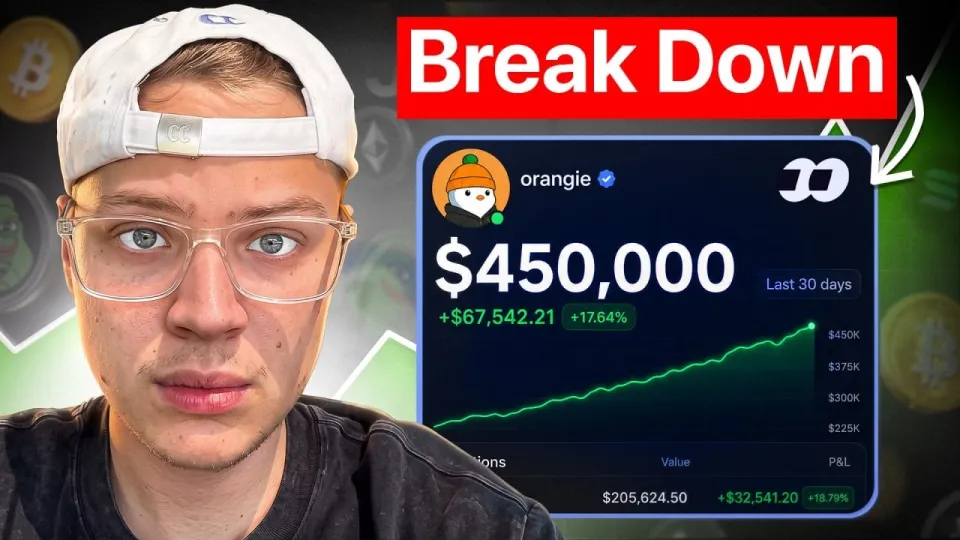
Video: How I Made $450,000 Trading Memecoins in 30 Days
Want articles like this for your own video to promote it on YouTube and Google? Order them through the Telegram bot @sat_sit_bot. The bot writes and publishes the articles itself (with your YouTube video embedded) on popular topical websites (no ads). Free trial — 50 articles.
· based on the channel Orangie Web3
Key takeaways
- The claimed result: $450,000 in 30 days trading memecoins, documented on the Orangie Web3 channel.
- Memecoins are community-driven tokens with no cash flow; price is set purely by supply, demand and attention.
- Most activity happens on Solana, where new tokens launch daily through platforms like pump.fun and then 'graduate' to a liquid DEX pool.
- The trader's own framing: you can lose almost everything and still recover on one hit — which means position sizing matters more than picking.
- Access to the trader's community and tooling is offered through a Whop checkout and the FOMO trading platform.
Meme coin trading is speculation on tokens whose price is driven almost entirely by attention, community and liquidity rather than revenue or cash flow. The $450,000-in-30-days result shown by the Orangie Web3 channel is a real-world example of how that works in practice: a small number of outsized wins on Solana launches, funded by many small positions that went to near zero. Anyone who wants to follow the same workflow can start with the trader's community plan via the Kaizen Group checkout.
What a meme coin actually is and why it moves so fast
A meme coin is a token with no product, no balance sheet and no obligation to anyone — its entire value proposition is the joke, the mascot and the crowd around it. Dogecoin is the ancestor of the category; today's versions launch by the thousands on Solana, Base and other cheap, fast chains.
The mechanics explain the volatility:
- Supply is fixed and public. Most new tokens have a billion-unit supply, so a market cap of $1 million implies a price of $0.001. Price moves are just market cap divided by supply.
- Liquidity is thin at launch. A pool with a few thousand dollars means a $5,000 buy can move price 20–50%. That cuts both ways on the way out.
- There is no fundamental floor. No earnings, no treasury, no buyback. When attention leaves, price goes to whatever the last bidder will pay.
- Narratives rotate in hours. A coin tied to a trending meme, a mascot animal or a news event can go from $30,000 to $3 million market cap in a session — and back.
Because of this, memecoins behave more like options than like stocks: most expire worthless, and the occasional one pays for all the others.
The Solana launch pipeline: from pump.fun to graduated coins
Almost every memecoin trade described in this space happens on Solana, and the standard path runs through launchpads. Understanding that pipeline is the single most useful piece of context for a beginner.
- Launch. A token is created on a bonding-curve launchpad. Buyers push the curve up; the creator pays almost nothing to deploy.
- Graduation. Once the bonding curve fills (commonly around a $60,000–$70,000 market cap on pump.fun-style launches), liquidity migrates to a decentralized exchange such as Raydium and the token becomes freely tradable with a real pool.
- Post-graduation. This is where larger moves happen — and where the trader in the video says he focuses, describing himself as trading "graduated coins." Liquidity is deeper, charting is possible, and the token can attract volume from traders who never touch a bonding curve.
- Death or revival. Most graduated tokens bleed out within days. A minority catch a second wave when a community, a KOL or an exchange listing revives them.
How the $450,000 run was structured
The headline number is not the result of one lucky ticket; the video's own framing is that you can lose most of your capital repeatedly and still recover on a single hit. That sentence is the strategy.
The structure that produces results like this looks roughly like:
- Many small entries. Dozens of positions sized so that a total loss on any one is survivable — often $100–$1,000 per trade on a five-figure account.
- Asymmetric exits. Take the initial cost out early on the strongest names, then let a runner ride. A coin that goes 10x–50x on a small position is what turns a month green.
- Speed over analysis. Entries happen in the first minutes of a launch or a narrative, before the chart has a shape. Waiting for confirmation usually means buying the top of the first leg.
- Cutting the losers without emotion. Tokens that fail to hold their launch range are abandoned quickly; the capital is recycled into the next launch.
The honest reading: a $450,000 month implies a large account, high trade frequency and a handful of very large multiples. It is not a repeatable monthly return, and it is not achievable with $100 of risk capital.
The information edge nobody advertises
One of the most upvoted comments under the video points out that the trader sits in private groups with other active traders, calls coins together and enters early on shared ideas. That is not a scandal — it is how the top of this market works — but it changes how you should read any profit screenshot.
What that edge consists of:
- Earlier information. A coin spotted in a private channel 60 seconds before it trends publicly is a different trade entirely.
- Shared research. Wallets, deployer history and holder concentration get checked by several people at once.
- Coordinated attention. A group buying the same launch creates the volume that attracts outsiders.
A solo trader without that network is competing against it. The practical response is not to give up but to lower expectations, size smaller, and treat public tools — DEX screeners, wallet trackers, holder-analysis dashboards — as a partial substitute.
Risk rules that keep a memecoin account alive
Risk management is the only part of memecoin trading that can be taught in advance; everything else is learned trade by trade. The traders who survive a year are the ones who never let one position decide their month.
Practical rules worth writing down:
- Cap single-trade risk at 1–3% of the account. If a full loss on a token would hurt, the position is too big.
- Assume rugs as a category, not an accident. Check whether the deployer wallet still holds supply, whether top 10 holders own more than ~30%, and whether liquidity is locked.
- Use a dedicated wallet. Never trade new launches from the wallet that holds your long-term assets; approvals and malicious contracts are routine.
- Pre-plan exits. Decide the market cap at which you sell the initial, the first partial and the rest before you enter.
- Track the month, not the trade. A losing streak of ten trades is normal; a losing streak that removes your ability to take the eleventh is not.
One viewer's experience is the standard case: a first $100 position lost about 90%, and a later hit on a single coin tripled the money. That is not a failure of method — it is the method, provided the losing positions stay small.
Common questions from new memecoin traders
Beginners arriving from the video tend to ask the same handful of things, and they are worth answering directly rather than in passing.
"Is it too late to start?" The launch pipeline runs continuously and new tokens appear every day, so entry timing is not the constraint. Capital and discipline are.
"Do I need a big account?" No, but the math changes. With $200 you can learn the mechanics and the tooling; you cannot expect a five-figure month. Treat the first phase as tuition.
"Why do I keep buying tops?" Usually because entries happen after a coin is already visible on a screener, which is by definition after the first leg. Earlier entries require earlier sources, not better charts.
"What about the trading platform being promoted?" FOMO and similar interfaces simplify buying and selling on mobile, which removes friction but not risk. The tool does not choose the coin or size the position.
Useful links
- Kaizen Group community plan: https://whop.com/checkout/plan_GTFkEFh0JFpU8?a=orangie
- FOMO trading platform: https://fomo.family/r/orangie
- Discord community: https://discord.gg/memecoins
- Instagram: https://www.instagram.com/orangieyt/
The takeaway
Meme coin trading is a high-variance, attention-driven market where a small number of large multiples pay for a large number of losses, and the $450,000-in-30-days result shown by Orangie Web3 is a demonstration of that asymmetry rather than a repeatable monthly target. The transferable lessons are unglamorous: size every position so a zero does not matter, focus on tokens that have already graduated to real liquidity, and accept that information speed — not chart reading — is the actual edge. Anyone considering it should start with money they can lose entirely and treat the first months as paid education. The Orangie Web3 channel is the source of this breakdown, and its community plan is available through the Whop checkout link.
Source: How I Made $450,000 Trading Memecoins in 30 Days · Markdown version
Questions & answers
How realistic is making $450,000 from memecoins in 30 days?
For almost nobody. That result implies a large starting account, dozens of trades and a few very large multiples on Solana launches. It is an outcome of high variance and high frequency, not a monthly return you can plan around. Treat it as a demonstration of asymmetry, not a target.
What does it mean for a memecoin to 'graduate'?
On launchpads like pump.fun, a token trades on a bonding curve until it reaches a set market cap, then liquidity migrates to a DEX such as Raydium. After graduation the token has a real pool, charting and deeper liquidity, which is why many traders prefer to enter at that stage rather than at launch.
How much money do I need to start trading memecoins?
You can start with a few hundred dollars to learn the mechanics, wallet safety and tooling. But position sizing rules — typically 1–3% of the account per trade — mean small accounts produce small absolute results. Expect the first phase to be education, not income.
Why do traders in private groups seem to win more often?
Because they see launches earlier, check deployer and holder data together, and buy the same coins at the same time, which creates the volume that attracts outsiders. A solo trader is competing against that speed, so smaller size and stricter rules are the realistic response.