Can you really trade meme coins with a $10 portfolio and still come out ahead?
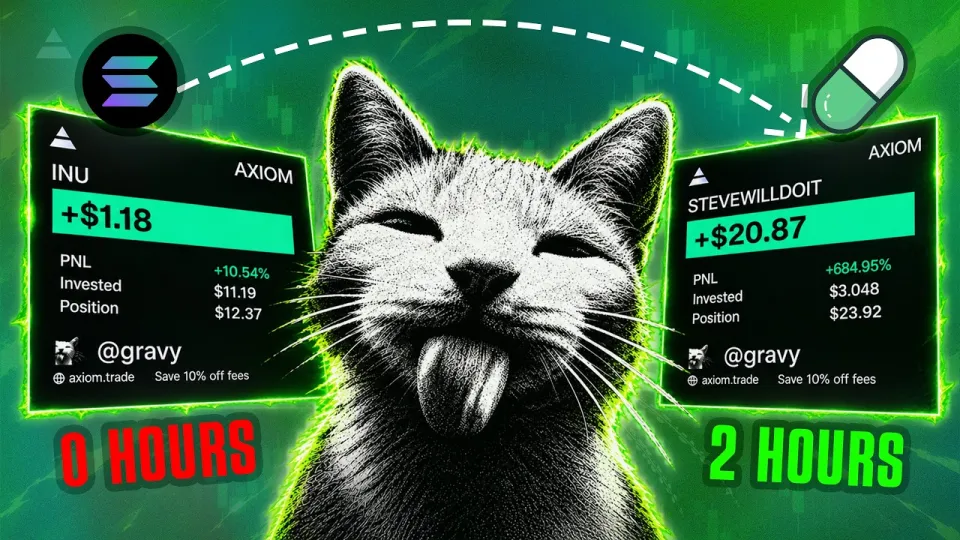
Video: I Tried Trading Memecoins with Just $10
Want articles like this for your own video to promote it on YouTube and Google? Order them through the Telegram bot @sat_sit_bot. The bot writes and publishes the articles itself (with your YouTube video embedded) on popular topical websites (no ads). Free trial — 50 articles.
· based on the channel gravy
Key takeaways
- Five trades, each buy capped at 0.05 SOL — roughly the size a $10 portfolio allows on Solana.
- Tickers traded: STEVEWILLDOIT, NPC, MET (Meteora), PUMPY the Trader and UNTXD.
- The X Money coin meta ran on an e/acc and Cream narrative, not on fundamentals.
- Axiom referral perks mentioned in the video: 2x cashback and 15% lower fees.
- The creator floated a follow-up: live trading from 0.1 SOL or 1 SOL with a doxxed wallet.
Yes — you can trade meme coins with a $10 portfolio, but only if every position is small enough that fees and slippage cannot erase the upside. A $10 bankroll on Solana is roughly 0.05 SOL per buy at typical prices, which is exactly the ceiling the creator of the «gravy» channel set for himself when he ran five real trades through Axiom, the trading terminal he used and recommends. The experiment shows the mechanics work; what decides the outcome is narrative selection and exit discipline, not account size.
What $10 actually buys you in meme coin trading
A small portfolio changes the math of meme coin trading more than it changes the strategy. On Solana you pay a network fee per transaction, a swap or aggregator fee, and slippage on thin liquidity, so a $10 position that moves 30% can still net far less than 30%. The video's rule — no single buy above 0.05 SOL — keeps each position large enough to matter relative to the bankroll but small enough that a total loss does not end the experiment. That is the core argument against the common claim that fees and taxes eat everything: at 0.05 SOL per trade the fixed costs are painful in percentage terms, but they are survivable, and one clean runner pays for several losers.
The five trades and the narratives behind them
The five trades in the video were chosen for story first and chart second, which is how most short-horizon meme coin trading actually works. In order, the positions were:
- STEVEWILLDOIT — a personality-driven ticker riding an existing meme rather than a new one.
- NPC — a coin built on the non-player-character internet joke, a format that spreads fast on social feeds.
- MET (Meteora) — a ticker tied to a real Solana liquidity protocol, which gives the trade a recognizable name to anchor the hype.
- PUMPY the Trader — a character coin in the pump.fun tradition, where launch mechanics and early holder behaviour matter more than any roadmap.
- UNTXD — the trade the creator admits he fumbled, which is the most instructive one in the set.
The X Money coin meta that framed part of the session is a good example of how these narratives form: it ran on e/acc and Cream associations rather than on any product news. Traders who understood the reference bought the story early; traders who waited for confirmation bought the top.
Why narrative timing beats chart reading on small accounts
On a $10 portfolio, narrative timing is the only edge that scales. A 0.05 SOL buy cannot move a market, cannot accumulate a position over days, and cannot survive a long drawdown, so the entire return comes from being early to a story other people will recognize within hours. That means watching who is talking about a ticker, how fast the mentions are compounding, and whether the joke is legible to someone outside the niche. A coin tied to a known protocol name or a widely shared character has a lower explanation cost than an abstract ticker, which is why Meteora-linked and character coins keep appearing in these rotations.
The mistake that cost the most
The costly mistake in the experiment was an exit problem, not an entry problem. Holding a position past the point where the narrative stopped compounding turned a workable trade into a fumble, and that pattern matches what most small-account traders report: they sell winners after a 20–40% loss of patience and then watch the same coin run without them. The practical fix is mechanical — decide before buying what invalidates the story, and treat a stalled mention count as invalidation just as seriously as a red candle.
Common questions from small-account traders
Three doubts come up again and again around low-balance meme coin trading. First, consistency in finding good narratives: the answer is a curated feed rather than a general one, following the accounts that historically surface tickers early and muting everything else, because scanning every post is not survivable at human speed. Second, position sizing: with $10, spreading across more than three or four names guarantees that fees dominate the result, so concentration is a feature, not a flaw. Third, record keeping: several viewers of the experiment asked for the final profit-and-loss figure, and the honest lesson is that a trade log with entry, exit, fees and thesis is the only way to know whether a strategy is working or whether a single lucky runner is masking ten bad decisions.
Useful links
- Axiom trading terminal with the creator's referral — the terminal used for all five trades, with 2x cashback and 15% lower fees through the link.
- The Trenches Discord
- Discord with free Axiom imports and trade signals (NFA)
- gravy on X
- Bitbase leveraged trading with a 20% futures fee reduction
Bottom line
Trading meme coins with $10 is possible, but the constraint is discipline rather than capital: 0.05 SOL positions, a narrative you can explain in one sentence, and an exit rule written before entry. The five-trade experiment on the «gravy» channel is useful precisely because it includes a fumble alongside the wins, and because it treats fees as a design constraint instead of an excuse. Anyone repeating it should log every trade and compare results against a simple benchmark: holding the same $10 in SOL. If you want to run the same setup, start through the Axiom referral link and keep the first position at 0.05 SOL or below.
Source: I Tried Trading Memecoins with Just $10 · Markdown version
Questions & answers
How much is 0.05 SOL in dollars for a $10 portfolio?
At typical Solana prices a $10 bankroll is roughly 0.05 SOL, which is why the experiment capped every buy at that level. The exact dollar figure moves with the SOL price, so recalculate the cap before each session rather than fixing a dollar amount.
Do fees make small meme coin trades pointless?
Fees hurt in percentage terms but do not make small trades pointless if each position is large enough relative to the bankroll. The real risk is overtrading: spreading $10 across many names multiplies fixed costs and slippage until no single winner can cover them.
How do traders find meme coin narratives early?
Most of the work is feed curation — following accounts that historically surface tickers before they trend and ignoring broad chatter. A narrative worth buying can usually be explained in one sentence and is tied to a recognizable name, character or protocol.
Should a beginner start with 0.1 SOL or 1 SOL?
Starting with 0.1 SOL keeps the cost of mistakes low while still forcing real fee and slippage decisions, which is the point of the exercise. A 1 SOL start makes results more meaningful but also makes early errors more expensive, so it suits traders who already have an exit rule.